The Rain of Sulfur
Subtitle: Why the ‘Righteous’ were actually the villains.
🎥 Introduction to the Narrative Script: “The Sulfur Project” Movie
To set the stage on your blog, you need an intro that warns the reader they are about to see the “B-roll” and “Deleted Scenes” the church edited out.
The Hook: “Every blockbuster has a Director’s Cut—the version where the hero is actually a sociopath and the ‘happy ending’ is a psychological crime scene. For thousands of years, the story of Sodom has been produced by apologists as a tale of divine justice. But today, we’re putting on our Logic-Blades and looking at the original Narrative Treatment.”
The Setup: “In this version, we pan the camera away from the ‘holy’ light to see the shadows. We see a Director who doesn’t just watch the tragedy; he scripts it. He targets a family, removes their autonomy through a Willusion (the illusion of choice), and engineers a scenario where the only survivors are left in a cycle of trauma and incest. Welcome to the Director’s Cut of the End of the World.”
🎭 Act 1: The Cosmic Business Deal (Genesis 18)
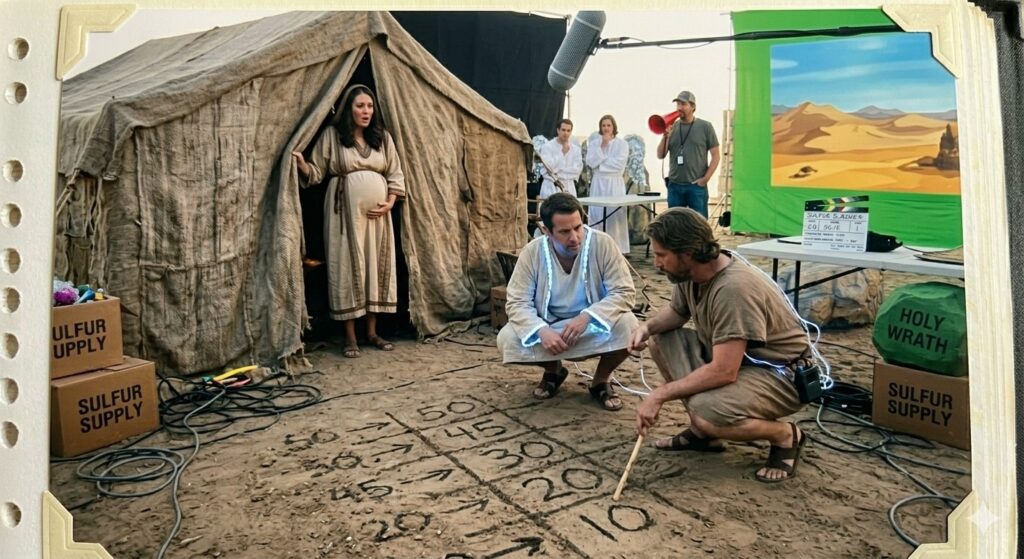
The movie starts with a shady negotiation in the desert. Abraham is haggling with the Director (God) like they’re at a used car lot.
- The Stake: The lives of thousands, including infants and animals.
- The Price: Abraham asks, “What if there are 50 good people? 40? 30? 20? How about 10?”
- The Director’s Response: “For the sake of ten, I will not destroy it.”
- The Plot Hole: If the Director is all-knowing, He already knows there aren’t ten. This negotiation is just performative cruelty—a script designed to make the Director look “fair” before he drops the napalm.
🏠 Act 2: Defining “Righteous”
The camera pans to the only family the Director decides to save. If these are the “Top 0.1%” of humanity, the world is in trouble.
- Lot: The “Hero” who offers his own virgin daughters to be gang-raped and likely murdered to protect two “Alien Invaders” (Angels).
- The Daughters: The “Survivors” who end the movie by druging and raping their own father.
- The Logic-Blade: In this script, “Righteousness” doesn’t mean being a good person; it just means being on the Director’s “Protected List.”
🛡️ Act 3: The “Invisifact Shield” vs. The Mob
Traditional preachers claim the mob was “only men.” Our Director’s Cut uses the Logic-Blade to look at the Hebrew text (Kol-ha-am – All the people).
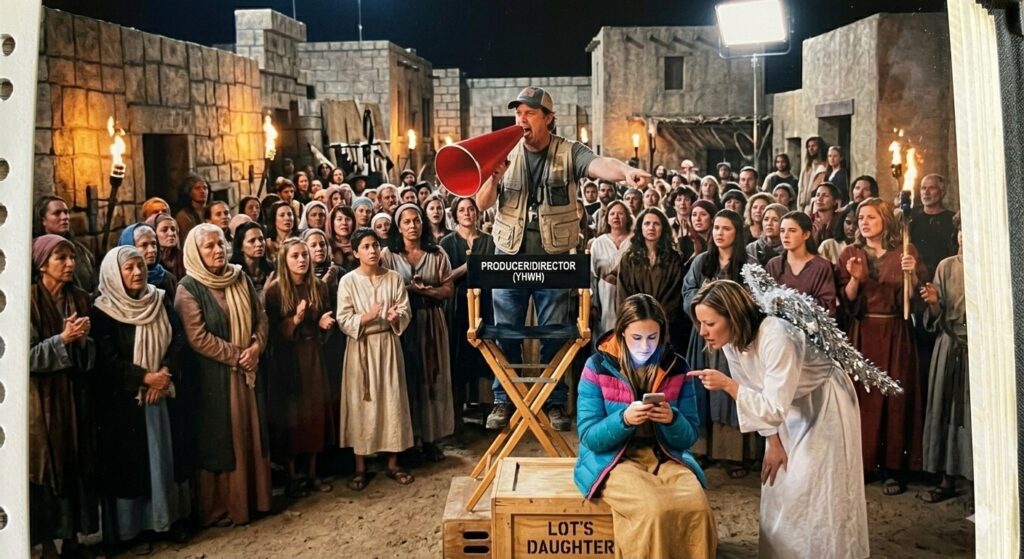
- The Scene: The camera shows the Cis-Straight Women of Sodom leading the charge.
- The Motivation: They aren’t “gay.” They are a neighborhood watch rejecting “Alien Invaders.”
- The Rejection: When Lot offers them his daughters, the mob says NO. They aren’t interested in raping children; they want the intruders out.
- The Shift: The “Bad Guys” (the mob) actually show more restraint than the “Good Guy” (Lot), who was ready to throw his kids to them.
🔥 Act 4: The Final Body Count
The Director decides the “test” failed.
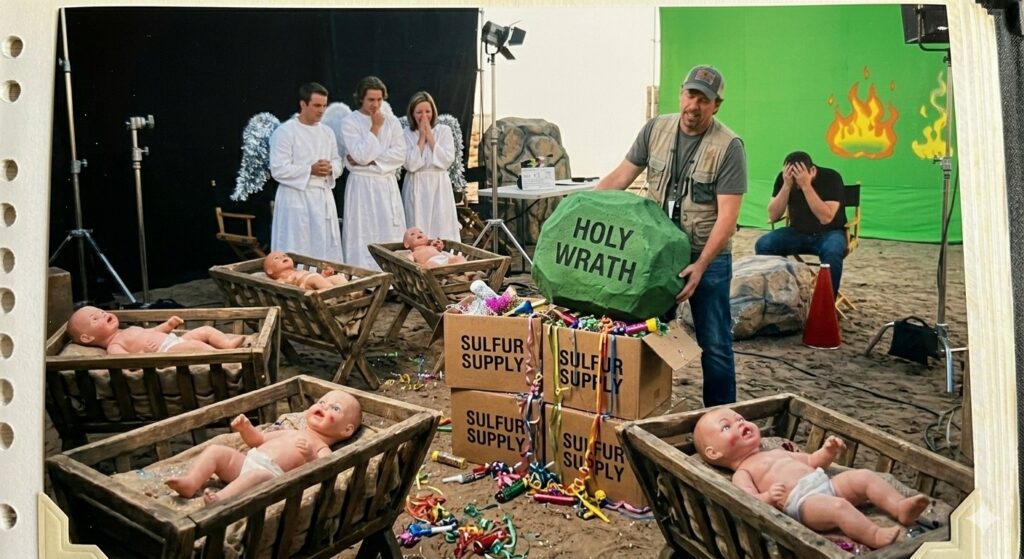
- The Victims: The camera lingers on the Innocents—the babies in their cribs, the toddlers playing in the dirt. They weren’t part of the negotiation. They didn’t have a choice (Willusion).
- The Executioner: The Director drops the sulfur.
🎬 The Sulfur Script: Act 5 — The Psychological Trap
Scene 1: The “Hate” for Happiness
The camera shows a flashback of Lot’s family before the angels arrived. It’s a peaceful, boring afternoon in Sodom.
- The Visual: Lot’s daughters are laughing with their fiancé’s (the “sons-in-law” mentioned in Genesis 19:14). They are planning weddings. They are happy.
- The Director’s POV: From the 11th dimension, the Director watches with disgust. He doesn’t want “happily ever after.” He wants WILLIOLATE (a cognitive hijack where an external agent rewrites thoughts). He needs a family that is broken, isolated, and dependent only on Him.
Scene 2: The Groom’s Rejection
When the “Producer” sends the angels to “save” the family, it’s actually a move to break them. Lot runs to his future sons-in-law to warn them.
- The Reality: The sons-in-law think he’s joking. Why wouldn’t they? The city is fine. The “threat” is invisible.
- The Result: The Director successfully cuts the daughters off from their partners, leaving them traumatized and alone with their creepy, child-sacrificing father.
Scene 3: The OCD Trap (Lot’s Wife)
Now the camera focuses on the most petty act of the movie.
- The Character Note: Lot’s wife is portrayed as having high anxiety and a need for closure (OCD). She needs to see the world one last time to process the “Onto-violation” (the existential breach of her home being stolen).
- The Trap: The Director gives a specific, arbitrary command: “Don’t look back.” He knows her nature. He knows she will look.
- The Execution: As she turns—not out of rebellion, but out of a desperate, human need to see what happened to her life—the Director “pillar-of-salts” her. He deletes the mother so the father and daughters are left in a cave with no moral compass.
Scene 4: The Incest Rape Finale
The camera follows them into the cave. The Director has finally achieved his perfect set-up.
- The Isolation: No husbands. No mother. Just a drunk father and two girls who have seen their world burn and dead fiancee.
- The Director’s Smile: This wasn’t an accident. The Director likes the outcome. He prefers a world of broken, incestuous “righteous” people who fear Him over a city of “sinners” who were just trying to live their lives.
🗡️ The Logic-Blade Review
When we use our Logic-Blade, the “Invisifact” of God’s “Justice” vanishes.
- The Sabotage: The Director didn’t save Lot from Sodom; He destroyed Lot’s family using Sodom.
- The Willusion: The believers think Lot was “blessed” to escape, but the “blessing” was the destruction of his wife and the sexual violation of his own body.
- The Goal: The Director hates peace because peace doesn’t require a Savior. He creates the fire so He can be the only exit door.
🎭 The “Bad” Actors (The Protagonists)
In any normal movie, these people would be the first to go. But here, they are the “heroes”:
- God as The ultimate villain.
- Lot (The “Righteous” Father): Our lead actor. His first big scene? Offering his own virgin daughters to a violent, horny mob to be gang-raped and likely murdered just to protect two houseguests he barely knows. In any modern thriller, Lot is the villain who gets caught by the police in the first ten minutes.
- The Daughters (The Sequel Plot): After escaping the fire, they decide the best way to “save the human race” is to get their father blackout drunk and rape him—twice. This isn’t a holy story; it’s a disturbing family psychodrama.
👶 The Real Victims (The Extras)
The script treats them like background props, but they are the true tragedy:
- The Innocents: The story claims “everyone” was bad. Really? The toddlers? The newborns? The puppies? The local baker who just wanted to sell bread?
- Lot’s wife.
- The Collateral Damage: Thousands of lives snuffed out by a “hero” deity because of the actions of a few. This is the Massive Overkill trope taken to a cosmic level.
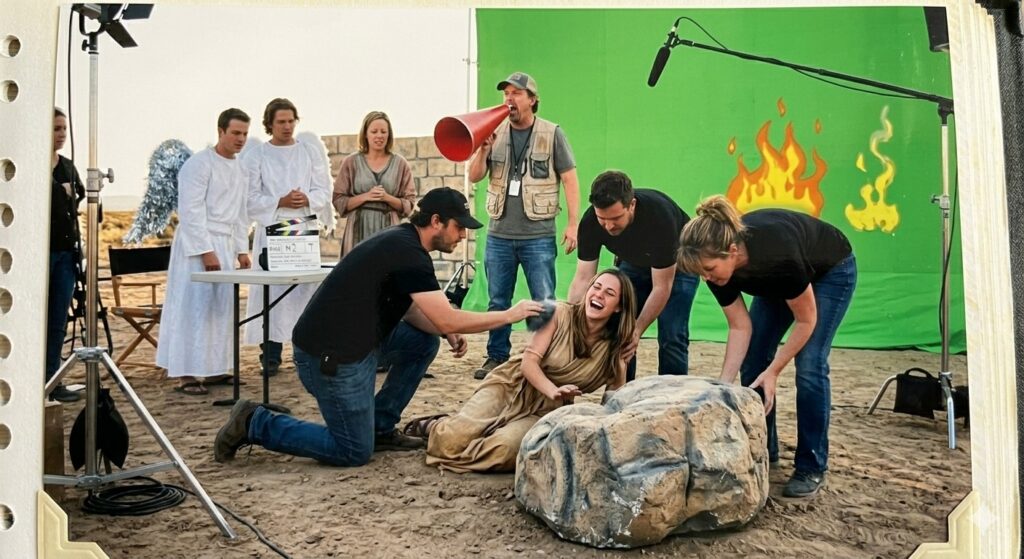
🌀 The Twists (The Bad Writing)
1. The “Invisible” Evidence: The biggest twist is that there is zero evidence for any of this. It’s a classic Invisifact (a claim that hides in the past to avoid proof). The “sulfur” and the “fire” are just special effects used to justify a local geological feature—the saltiness of the Dead Sea.
2. The Salt Shaker Finale: Lot’s wife gets turned into a pillar of salt for looking at her house burning down. Meanwhile, the Producer ignores the daughters’ incestuous rape of their father. In this movie, “Justice” is a random number generator.
3. The Gender Mystery: The story claims the crowd wanted to “know” the visitors. We assume it’s men, but the text is vague. It is literally more likely that it was a crowd of confused women or a mixed neighborhood protest than a deity manually aiming sulfur-missiles at a crib.
The Hebrew Breakdown: Genesis 19:4
The phrase used is:
אַנְשֵׁי הָעִיר אַנְשֵׁי סְדֹם
…כָּל
–הָעָם מִקָּצֶה
(Anshei ha-ir, anshei Sedom … kol-ha-am mi-katzeh)
Here is the “Internal Criticism” of that text:
- “Anshei” (אַנְשֵׁי): This is the plural of enosh or ish. While it often means “men,” in ancient Hebrew (much like “mankind” in old English), it is frequently used as a collective term for “people” or “inhabitants.”
- “Kol-ha-am” (כָּל–הָעָם): This is the “Smoking Gun.” Kol means “All” and Ha-am means “The People.” 3. “Mi-katzeh” (מִקָּצֶה): This literally means “from every quarter” or “to the last extremity.” ### The Director’s Cut Interpretation If the “Producer” (God) is going to destroy the entire city—women, babies, and grandmothers—the text has to justify it by saying “everyone” was there.
If it was only the men, then the “Producer” just committed a massive war crime by killing all the women and children who were home sleeping. To avoid being the “Ultimate Bad Guy,” the story claims “all the people” (Kol-ha-am) were there.
Since the text says “all the people,” our camera pans out to show the cis-straight women in the crowd. Why are they there?
- They aren’t there for “gay” reasons.
- They are there because they are a xenophobic mob protecting their turf from “alien” invaders (the angels).
- They reject Lot’s daughters because they don’t want women; they want the “outsiders” out.
- Or maybe in different hypothesis, Some of the mob straight ladies probably like em hot freshly fallen from sky angels.
Even if we follow the traditional “men only” script, it makes the “Producer” look even worse.
- The Injustice: God saves Lot (the guy who offered his kids to a mob) and his daughters (the future rapists).
- The Innocents: God murders every woman and child in the city who wasn’t at the door.
By using the “all the people” translation, we expose the Invisifact (the unfalsifiable claim that everyone was evil). It’s a convenient narrative shield to hide the fact that the “hero” of the story killed thousands of innocent babies.
🎭 The Script Analysis: “Knowing” and “Brothers”
1. The “Knowing” (Yada – יָדַע): Yes, in this context, “know” is widely accepted as a euphemism for sex. But here is the Horror Twist: In the ancient world, “raping the outsider” wasn’t necessarily about sexual orientation—it was about Dominance and Humiliation. By “knowing” the visitors, the mob (the “Bad Actors”) wanted to strip these “Alien Invaders” of their dignity and power.
2. The “Brothers” (Achai – אַחַי): You caught Lot saying, “I beg you, my brothers, do not act so wickedly.”
- The Apologist View: “See? He said ‘brothers,’ so it’s only men!”
- The Kaloon.org View: In Hebrew, “Brothers” (Achim) is the standard collective term for a group of people, even if women are present (much like “Guys” or “Brothers and Sisters” in a sermon).
- The Plot Hole: If Lot only addressed the men, then where was the rest of the city? If the “Producer” (God) killed the women and babies who weren’t at the door, He is a war criminal.
- If they were at the door, Lot was addressing a mixed crowd using the masculine plural (standard Hebrew grammar). and god tried to protect his little criminal family from righteous people. either way it doesn’t look good.
🗡️ The External Logic-Blade Summary
This isn’t a story about “sin.” It’s a story about a Bad Director protecting a Rapist Family from a Good Mob that simply wanted their city back.
The traditional “LGBT narrative” is a distraction. The real horror is a deity who defines “Good” as a man willing to pimp out his children.